
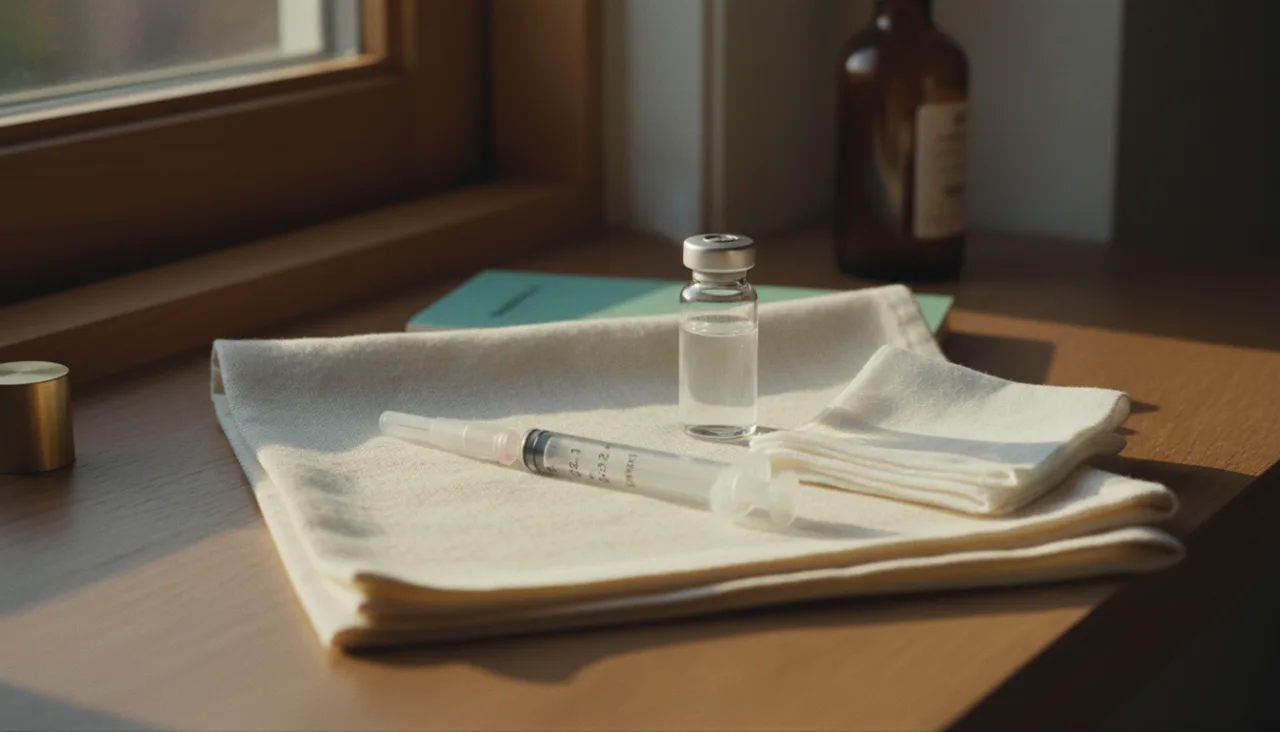
Air bubble in a peptide syringe: does it matter?
The most-Googled injection-FAQ question, answered honestly.
TL;DR
- For a subcutaneous peptide injection, a small air bubble in the syringe is generally harmless — the fat layer absorbs it without consequence.
- Air embolism is an intravenous risk that requires much larger air volumes than fit in a peptide syringe.
- You can still expel the bubble for accuracy: hold the syringe needle-up, tap, push the plunger until a small drop appears at the tip.
What it is
A peptide syringe is the small, fine-gauge insulin syringe most peptides are drawn into after reconstitution (in plain English: after the powder is mixed with bacteriostatic water). Picture a slender plastic tube about the size of a pencil lead. After drawing the dose, a tiny air bubble often appears against the plunger. That bubble is what people see and worry about. The volume is usually less than a tenth of a milliliter.
How it works
Subcutaneous injection deposits the medication into the fat just beneath the skin. The fat layer is not a closed vessel — it is a loose tissue that absorbs small volumes of fluid and the tiny amount of air a peptide syringe could hold. Air embolism (in plain English: a dangerous air-in-the-bloodstream event) requires an intravenous route and a much larger air volume — usually more than 50 milliliters in adults (MedlinePlus subcutaneous injection guide).
Who asks about it
People come to this question after their first or second self-injection. They see the bubble. They have heard the nurse-show warnings about air in the line. They want to know whether the bubble is the problem the internet says it is.
What the research says
Subcutaneous injection guidance from nursing references and from the CDC's clinician administration guides treats small air volumes in fine-gauge syringes as a non-event for the subcutaneous route. Air embolism cases in the published literature are tied to intravenous access, central lines, or surgical scenarios — not insulin-syringe peptide injections (CDC vaccine administration guidance). About 9 in 10 self-injected peptide doses arrive at the right tissue depth with the right volume even when a small bubble is present.
What to know before considering it
The real reason to expel a bubble is dose accuracy. A peptide dose is small — a tenth of a milliliter matters. If your bubble is large enough to shift the meniscus, redraw and recount. Always inspect the syringe before injection, swap the needle if it is dull, and rotate sites to avoid lipohypertrophy (in plain English: fat bumps under the skin from repeated injection at the same spot).
The Halftime POV
The air-bubble panic is one of the most common questions new patients ask, and the honest answer is reassuring. For a subcutaneous peptide injection, a small bubble is not a clinical event. Worry instead about dose accuracy, site rotation, and the certificate of analysis on the vial. Those are the variables that actually decide whether a peptide protocol works.
Related reading:
- Peptide injection technique: the basic primer
- The peptide injection needle guide
- Reconstituting peptides: the step-by-step
- Minimizing injection pain at home
FAQ
Q: Is a small air bubble in a peptide syringe dangerous? A: For subcutaneous peptide injections, a small air bubble is generally harmless. The fat layer absorbs the tiny volume of air without consequence. Air embolism risks are tied to intravenous routes and much larger air volumes than fit in an insulin syringe.
Q: How do you get rid of an air bubble in a peptide syringe? A: Hold the syringe needle-up, tap the barrel to send the bubble to the top, then push the plunger slowly until a small drop of liquid appears at the needle tip. Re-check the dose volume before injecting.
Q: What if I already injected a small air bubble? A: For subcutaneous injection, a small bubble is not a clinical event. Note it, do not redose, and continue your schedule. Call your prescriber if you see any local reaction beyond mild bruising.
Disclaimer
This article is educational and is not medical advice. Compounded medications are not FDA-approved. Clinical outcomes depend on individual factors and require physician evaluation. Results vary. Halftime Health is launching soon — join the waitlist to get updates.
Get updates
Halftime Health is launching soon. We'll share what we learn along the way — the research, the regulations, the real-world trade-offs. Join the waitlist and we'll email you when we're live.
Sources
Frequently asked questions
Is a small air bubble in a peptide syringe dangerous?
For subcutaneous peptide injections, a small air bubble is generally harmless. The fat layer absorbs the tiny volume of air without consequence. Air embolism risks are tied to intravenous routes and much larger air volumes than fit in an insulin syringe.
How do you get rid of an air bubble in a peptide syringe?
Hold the syringe needle-up, tap the barrel to send the bubble to the top, then push the plunger slowly until a small drop of liquid appears at the needle tip. Re-check the dose volume before injecting.
What if I already injected a small air bubble?
For subcutaneous injection, a small bubble is not a clinical event. Note it, do not redose, and continue your schedule. Call your prescriber if you see any local reaction beyond mild bruising.
Keep reading

A licensed physician can build a protocol from your own labs.
Membership from $69/mo, including your onboarding panel. Each protocol is its own monthly subscription.