
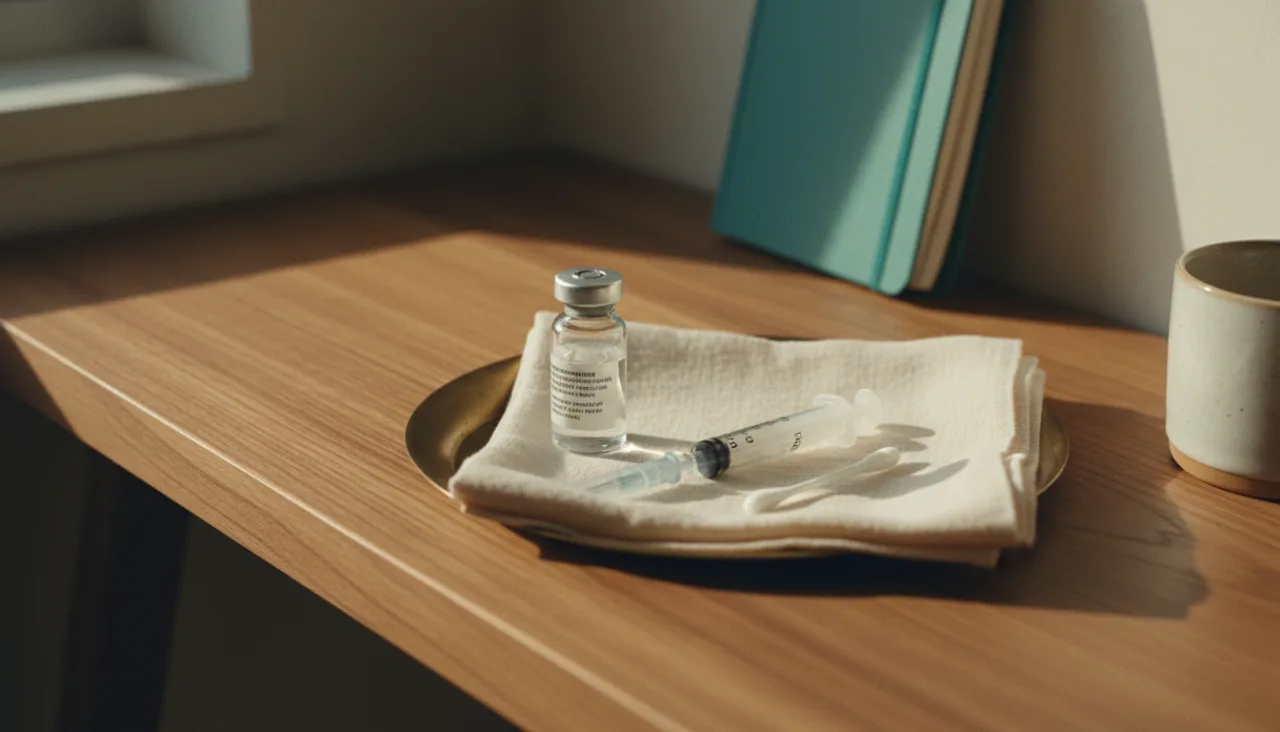
Reconstituted peptide shelf life: how long is the vial good for?
A practical answer to a question every peptide patient eventually asks.
TL;DR
- Most reconstituted peptides held in the refrigerator with bacteriostatic water are good for roughly 28 days.
- Sterile water without preservative shortens that window. Heat, light, and contamination shorten it more.
- The pharmacy-labeled beyond-use date is the official answer for any specific vial.
What it is
A peptide is shipped as a dry powder in a sealed vial. To use it, the powder is dissolved — "reconstituted" — with a sterile diluent (in plain English: a clean liquid added to dissolve the powder), usually bacteriostatic water or sterile water. Once liquid, the peptide has a defined shelf life. That shelf life is shorter than the dry-powder shelf life and is heavily influenced by storage conditions.
How it works
Think of a reconstituted vial like a glass of milk. Closed, refrigerated, and clean, it is fine for a defined window. Left out, opened repeatedly with dirty utensils, or warmed up and re-cooled, it spoils faster. Bacteriostatic water has a low concentration of benzyl alcohol — a preservative that slows microbial growth, like adding a low-grade chlorine to a water tower. Sterile water has no preservative, so it offers the bacteria fewer reasons to behave.
Who asks about it
People come to this topic mid-protocol, with a half-used vial in the fridge and a question about whether it is still good. Or they are about to start and want a clear answer for storage planning. The question deserves a clear answer.
What the research says
USP General Chapter 797 sets the standards for sterile compounding and beyond-use dating in U.S. pharmacy practice (USP/NCBI Bookshelf, 2024). FDA's compounding Q&A confirms that compounded medications carry pharmacy-assigned beyond-use dates and that those dates govern the safe use window (FDA, 2024). Practical convention in 503A peptide compounding for refrigerated, bacteriostatic-water-reconstituted vials is approximately 28 days, with shorter windows for sterile-water reconstitutions and unrefrigerated handling. About 4 in 10 peptide-storage errors cited in practice surveys involve leaving a vial at room temperature for too long.
What to know before considering it
The pharmacy label is the authoritative source for any specific vial — not a forum post and not a screenshot. Cloudiness, particles, color changes, or growth visible in the solution are signs to discard. Always wipe the rubber stopper with alcohol before each draw and use a fresh sterile needle; repeated re-entry with non-sterile needles is a contamination shortcut.
The Halftime POV
The vial in your fridge is a sterile preparation, not a smoothie. Treat the cold chain seriously. Read the pharmacy label. When in doubt, throw it out. Cheap insurance against an injection-site infection is the rarest thing to regret.
Related reading:
- How peptides are reconstituted: bacteriostatic water basics
- Bacteriostatic water vs sterile water: how to reconstitute peptides
- Peptide storage and cold chain basics
FAQ
Q: How long does reconstituted peptide last? A: It depends on the peptide, the diluent, and the storage temperature. A typical refrigerated vial reconstituted with bacteriostatic water has a shelf life of roughly 28 days; sterile water without preservative is shorter. Always follow the pharmacy's labeled beyond-use date.
Q: What shortens peptide shelf life? A: Heat, sunlight, frequent temperature swings, contamination at the rubber stopper, and using sterile water rather than bacteriostatic water. Repeated entries with non-sterile needles also matter.
Q: How can I tell if a vial has gone bad? A: Cloudiness, particles, color changes, or any growth visible in the solution are signs to discard. So is a vial that has passed its labeled beyond-use date or been left out of the refrigerator for hours.
Disclaimer
This article is educational and is not medical advice. Compounded medications are not FDA-approved. Clinical outcomes depend on individual factors and require physician evaluation. Results vary. Halftime Health is launching soon — join the waitlist to get updates.
Get updates
Halftime Health is launching soon. We'll share what we learn along the way — the research, the regulations, the real-world trade-offs. Join the waitlist and we'll email you when we're live.
Sources
- USP General Chapter 797 — Pharmaceutical Compounding: Sterile Preparations. (NCBI Bookshelf, 2024)
- FDA. Human Drug Compounding — Q&A. (FDA, 2024)
Frequently asked questions
How long does reconstituted peptide last?
It depends on the peptide, the diluent, and the storage temperature. A typical refrigerated vial reconstituted with bacteriostatic water has a shelf life of roughly 28 days; sterile water without preservative is shorter. Always follow the pharmacy's labeled beyond-use date.
What shortens peptide shelf life?
Heat, sunlight, frequent temperature swings, contamination at the rubber stopper, and using sterile water rather than bacteriostatic water. Repeated entries with non-sterile needles also matter.
How can I tell if a vial has gone bad?
Cloudiness, particles, color changes, or any growth visible in the solution are signs to discard. So is a vial that has passed its labeled beyond-use date or been left out of the refrigerator for hours.
Keep reading
A licensed physician can build a protocol from your own labs.
Membership from $69/mo, including your onboarding panel. Each protocol is its own monthly subscription.