
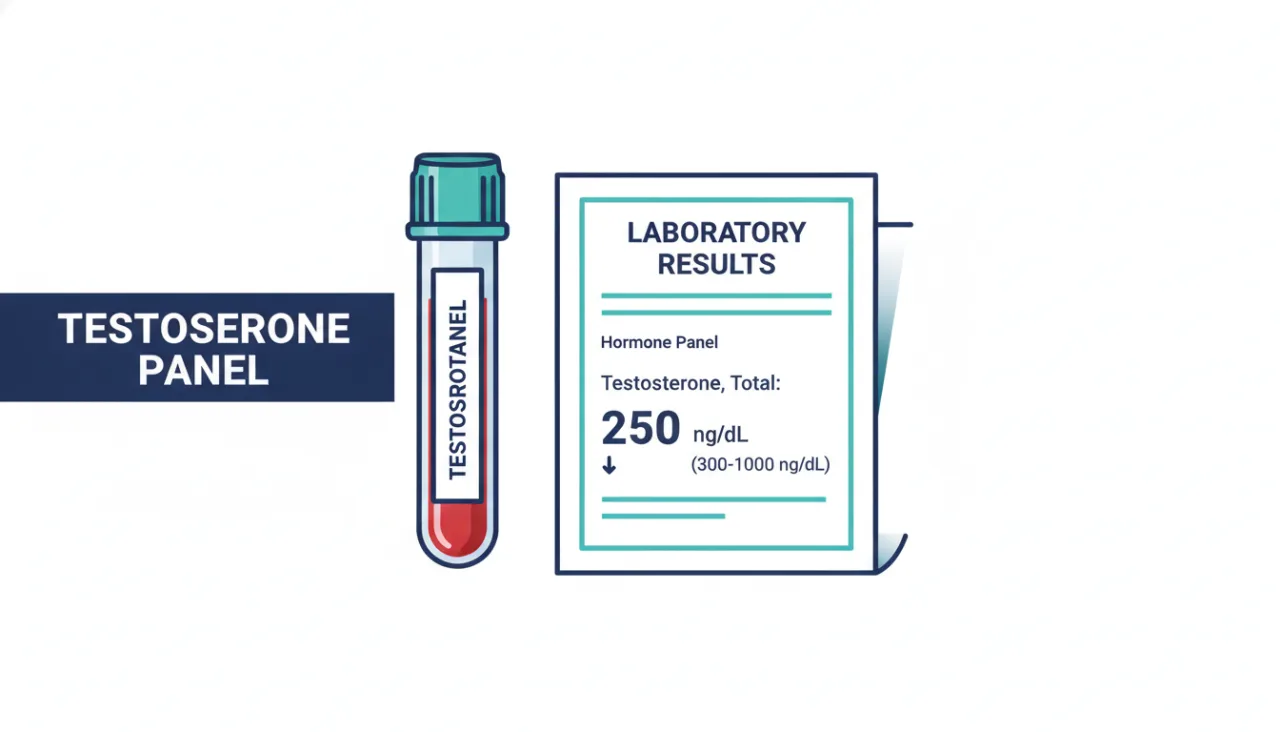
Who orders testosterone panels and what they are evaluating
Testosterone panels are ordered across a range of clinical settings — primary care, endocrinology, telehealth — but the trigger is almost always the same: a patient describing fatigue that does not resolve with sleep, lower libido, difficulty building or maintaining muscle, or unexplained changes in mood or body composition.
The Endocrine Society's 2018 clinical guidelines recommend testing when symptoms are present and other causes have been considered.
Who orders a testosterone blood test
Primary care physicians, internists, endocrinologists, and telehealth clinicians all order testosterone panels. The request typically comes after a patient raises symptoms. Men in their 40s and 50s are the most common cohort, but testosterone testing is also ordered in younger men with unexplained low energy or libido, and in women where hormonal evaluation is warranted.
What does a testosterone panel measure
A testosterone panel is a balance sheet for the body's hormonal supply — it counts not just how much testosterone exists in the blood, but how much is actually available to cells.
Total testosterone counts every testosterone molecule in the bloodstream, bound to proteins and free.
Free testosterone is the small fraction — roughly 2–3% — not attached to carrier proteins. This is the biologically active portion. A man can have a normal total testosterone reading and still feel low-T symptoms if free testosterone is suppressed.
SHBG (sex hormone-binding globulin — in plain English: a protein that carries testosterone through the blood) determines how much stays bound and unavailable. High SHBG can create a gap between normal-looking total testosterone and low-functioning free testosterone. A full testosterone panel interprets all three numbers together.
What is free testosterone vs total testosterone
Total testosterone counts both bound and unbound molecules. Free testosterone is the unbound share that cells can actually use. SHBG levels determine the ratio. Elevated SHBG — which rises naturally with age and in certain metabolic conditions — can push free testosterone low even when total looks fine.
This is why interpreting a testosterone number without context is unreliable. A clinician reviewing a men's midlife panel will look at the whole picture: total, free, SHBG, and symptoms together.
How often should testosterone be tested
Testosterone follows a circadian pattern — it peaks in the early morning and declines through the afternoon. Most clinicians recommend drawing blood before 10 a.m. for accuracy. A baseline result should be confirmed with a repeat morning draw 3–6 months later before any clinical decision is made, per Endocrine Society guidance. Understanding the fatigue and hormonal picture in men over 40 provides useful context for interpreting these numbers.
This article is educational and is not medical advice. Compounded medications are not FDA-approved. Clinical outcomes depend on individual factors and require physician evaluation. Results vary. Halftime Health is launching soon — join the waitlist to get updates.
Frequently asked questions
Who orders a testosterone blood test?
Primary care physicians, internists, endocrinologists, and telehealth clinicians order testosterone panels when a patient reports low energy, reduced libido, difficulty maintaining muscle, or unexplained mood changes.
What does a testosterone panel measure?
A standard panel measures total testosterone, free testosterone, and SHBG (sex hormone-binding globulin). Total counts all testosterone in the blood. Free testosterone — roughly 2–3% of total — is the biologically active fraction that cells can use directly.
What is free testosterone vs total testosterone?
Total testosterone includes both bound and unbound molecules. Free testosterone is the small unbound fraction available for immediate cellular use. SHBG levels determine how much stays bound. High SHBG can produce normal total testosterone but low free testosterone, along with low-T symptoms.
What numbers are clinicians looking for?
Most guidelines place the normal adult male range at roughly 300–1000 ng/dL for total testosterone, though optimal varies by individual. Clinicians look at free testosterone and SHBG alongside symptoms — not a single threshold number.
How often should testosterone be tested?
A baseline draw followed by a confirmatory test 3–6 months later is standard. Morning draws before 10 a.m. are preferred because testosterone peaks earlier in the day.
Keep reading



A licensed physician can build a protocol from your own labs.
Membership from $69/mo, including your onboarding panel. Each protocol is its own monthly subscription.