
Subcutaneous vs intramuscular injection: what the research shows
Most peptide protocols specify "subcutaneous injection." Patients who look up what that means — and how it compares to intramuscular — are asking the right question. The injection route affects how quickly medication enters the bloodstream, how it is dosed, and how easy it is to self-administer.
What is the difference between subQ and IM injections
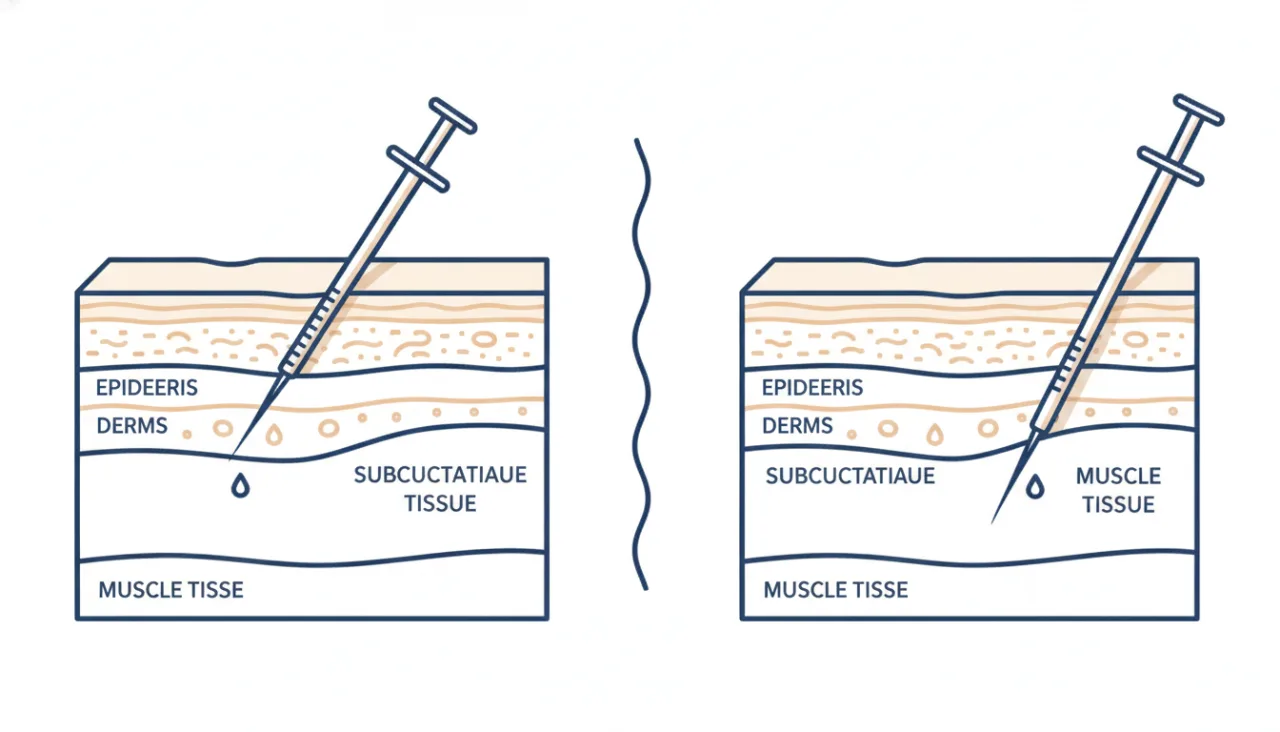
Subcutaneous injection (subQ or SC) delivers medication into the layer of fat just beneath the skin — typically the abdomen, upper arm, or thigh. Intramuscular injection (IM) goes deeper, into muscle belly tissue.
Think of it like inserting a pin into a foam cushion (subQ) versus pushing it into the firmer material underneath (IM). Both routes work. The key difference is how fast the medication moves into the bloodstream, which depends on how many blood vessels are nearby to carry it away.
A 2023 review in StatPearls (National Library of Medicine) confirms that subcutaneous absorption is generally slower and more prolonged than IM, while IM injections typically reach systemic circulation within 15–30 minutes. For most peptide compounds, that faster IM onset offers no clinical advantage — and the slower subQ curve is intentional.
Why are most peptides given subcutaneously
Muscle tissue is more vascularized than fat — it has a denser network of blood vessels. IM injections reach peak blood concentrations faster because medication is absorbed more quickly into that denser supply.
For peptides, however, the slower subQ absorption curve is usually preferred. Compounds like sermorelin, CJC-1295/ipamorelin, and bremelanotide are designed to produce a gradual, sustained effect rather than a rapid spike. A 2017 study in Drug Delivery found that subcutaneous administration of peptide-based drugs produces more consistent pharmacokinetic profiles compared to IM for most small-to-medium peptides.
SubQ also wins on practicality. The needles are shorter — typically 5–8mm, 29–31 gauge, similar to insulin syringes — and the technique is simpler to learn for home self-administration. Understanding why peptides need to be injected at all provides useful context here.
Subcutaneous vs intramuscular injection for peptides: the practical answer
For essentially all compounded peptide protocols currently prescribed through telehealth platforms, the answer is subcutaneous. The prescribing clinician's instructions specify the route, and they should be followed exactly. Converting a subQ protocol to IM without clinical guidance changes the absorption profile in ways that may affect both efficacy and safety — and is not recommended without explicit prescriber approval.
How subcutaneous injections work mechanically and how to reconstitute peptides properly are the practical next questions once the route is understood.
This article is educational and is not medical advice. Compounded medications are not FDA-approved. Clinical outcomes depend on individual factors and require physician evaluation. Results vary. Halftime Health is launching soon — join the waitlist to get updates.
Frequently asked questions
What is the difference between subcutaneous and intramuscular injection?
Subcutaneous (subQ) injection delivers medication into the fat layer just under the skin. Intramuscular (IM) injection delivers it into muscle. Muscle has more blood vessels, so IM absorbs faster. SubQ is slower and more sustained — which suits most peptide protocols.
Why are most peptides given subcutaneously?
Most peptides are given subQ because the slower, more consistent absorption rate matches how peptides work best — gradual release rather than a rapid spike. SubQ injections also use shorter needles and are easier to self-administer at home.
Does IM injection absorb faster than subQ?
Yes. Muscle tissue is more vascularized — it has a denser blood vessel network — so IM injections reach peak blood levels faster. For most peptides, however, the slower subQ absorption is actually preferred by clinical protocols.
Is subcutaneous injection painful?
Generally well-tolerated. The needle is short and thin, the fat layer has fewer nerve endings than muscle, and most people describe it as a minor pinch. Rotating injection sites reduces local irritation.
What needle is used for subQ peptide injections?
Most protocols specify a 29–31 gauge needle, 5–8mm in length — similar to an insulin syringe. The short needle reaches the fat layer without entering muscle.
Keep reading


A licensed physician can build a protocol from your own labs.
Membership from $69/mo, including your onboarding panel. Each protocol is its own monthly subscription.